Blockchain 101 – The Tech Behind Crypto

Introduction and Purpose
The recent surge of cryptocurrencies has piqued fresh interest towards the asset class. However, before you decide to yolo your life savings into DogeCoin based on some Twitter hype, it is imperative to grasp the technology that runs these tokens – Blockchain.
This blog seeks to explain the basic structure and principles of blockchain technology while also highlighting its vast array of potential applications. The hype around crypto advances the notion that blockchain is “bitcoin” or blockchain is just “crypto”, shrouding the actual depth of the technology. In reality, however, the plethora of applications that the technology has (and might have) dwarf the “currency” use case.
So, what is a blockchain?
A blockchain at its core is just another method to store data – a database. The differentiator here is how a blockchain stores the data. Data is stored in chronological groups or blocks, once the storage limitations of one block are met, a new block is formed sustaining the chronological store of data and hence, forming a chain of blocks.
Just visualize an everlasting snake game with the apples being new data and the snake being a database that constantly elongates.

Furthermore, all blocks in a blockchain are time-stamped and related to the block preceding them; this ensures that all the data stored is permanently recorded and transactions/operations are irreversible – a mechanism necessary to transact digital money.
Blockchain seeks legitimacy through widespread distribution of data. While a general database might be controlled by a single entity, a blockchain is distributed across all nodes or computers which are a part of the network. There is no central authority storing the data; instead, all the participants (nodes) maintain a copy of all the transactions taking place on the blockchain. This essentially bolsters safety because there in no single point of failure.
Blockchain’s decentralized approach advances transparency, legitimacy, and security while eliminating the need for trust.
Some features intrinsic to blockchain technology are –
- Decentralization – Data is stored across multiple nodes, there is no single point of control.
- Peer-to-peer nature – Value is transferred directly from one individual to another without being routed through a central authority.
- Transparency – Transactions are visible to all the participants, however, anonymity is still maintained.
- Irreversibility/Immutability – Transactions cannot be reversed/edited.
To elucidate, let’s take the example of your school canteen and your piling debt with them.
The school canteen maintains a record of all your “tendie” debt with them. Every time you borrow tendies, the canteen is the sole entity that records the transaction. Whatever that single ledger holds is enforceable upon the tendie borrower, you. The problem with this approach is that firstly, there is a trust requirement. You trust the canteen and hope they won’t just randomly add 2 tendies to the debt. Secondly, there is a single point of failure – if the class bully gets their hand on the canteen ledger they might reveal your crippling debt to the entire class, while this might lead to meager embarrassment in the example, it becomes a privacy issue in the macro perspective – think banking records, house records, medical records, search history, location data, etc.
This makeshift case study highlights 3 flaws – a trust requirement, the potential for manipulation, and a lack of privacy.
Now to advance our case study, we will place the canteen in the middle of the school auditorium, call all the students to sit in the auditorium, ensure that everyone wears a mask with a unique symbol (public key, an anonymous identification on a blockchain), and give everyone a pen and a paper to record all the transactions with the canteen.
Since the canteen is central to the auditorium, students can observe all the transactions and keep a record. In case the canteen adds the 2 random tendies, honest students will tend to notice and object to the addition, if a student tries to reduce their debt, this will once again be noticed as their record won’t match anyone else’s. Because all students wear a mask (blockchains have a public key to track transactions), their identities and hence their crippling debt will not be revealed – thus maintaining privacy. Our auditorium architecture will work until 51% of the students stay honest, to ensure that they stay honest we reward them for their efforts to update and validate all transactions – a small portion of those tendies keeps them happy.
Thus, this mechanism overcomes the flaws – it removes the need to trust a single entity, and since everyone maintains a record, manipulation of any transaction is nearly impossible. Furthermore, the mask (public key) ensures privacy. Therefore, our auditorium blockchain furthers legitimacy, privacy, and safety while maintaining transparency.
In the real world, our students will be “nodes” or computers that are part of the blockchain network. The transactions with the tendie vendor can be any form of data that the blockchain stores. The masks are public keys that help to track and authenticate transactions. Lastly, the incentives which are tendies can be any monetary/ non-monetary incentive. In the case of the bitcoin blockchain, nodes that verify transactions (called miners) are rewarded in Bitcoin.
The 7 Design Principles
We will now further our understanding by channelizing the blockchain mechanism into 7 design principles as put forth by Don and Alan Tapscott in “The Blockchain Revolution”.
#1 Networked Integrity
This principle basically highlights the networked nature of a blockchain which requires data to be stored and validated by multiple nodes across diverse geographical locations. This networked apparatus, supplemented by economic incentives, enables the blockchain to maintain integrity.
Taking the example of the bitcoin blockchain, the problem that was to be solved was the double-spend problem – the possibility of spending the same digital coin twice. In the traditional financial system, we rely on third-parties to overcome the double-spend problem – banks and credit card processing companies. This intermediation adds cost and time.
The bitcoin blockchain solved the problem through a culmination of code, math, and cryptography to develop a consensus system – an arrangement that enables all nodes to determine whether a transaction is legitimate or not, thereby eliminating the need for intermediation. The arrangement that bitcoin adopted is called Proof of Work (PoW), basically, all participating nodes rush to solve a mathematically generated puzzle that requires a lot of effort in the form of electricity and CPU power, this process is inherently wasteful in a way that it requires a lot of resources to undertake – a failsafe that hinders dishonest participants. Whoever solves the puzzle first gets to create the next block and is rewarded in Bitcoin. This also means that the longer a blockchain gets, the safer it becomes because of the sheer processing power that went into creating those blocks. Additionally, the elimination of intermediation significantly reduces the cost of transactions and saves time. Bitcoin transactions can be settled in as little as 10 minutes.
Through incentive, the bitcoin blockchain cleverly pivots the objectives of all the nodes towards maintaining integrity, a dishonest motive will not be economically profitable.
#2 Distributed Power
This is similar to what the case study explained, the data and the power to validate the data is distributed across tens of thousands of nodes across the blockchain. This essentially means that no single individual or group of individuals has the muscle to override the entire system. Furthermore, the PoW mechanism makes it infeasible to economically gain from being the bad guys.
Our data is monetized to enable firms to increase their reach, and in many instances without our consent. Furthermore, as single points of failure, these institutions witness major breaches of data, putting our privacy at stake. The blockchain infrastructure curtails exploitation of our data.
#3 Value as Incentive
Blockchains automatically align the varying self-interests of all participating nodes towards benefitting the whole system. There might be no central authority to manage the participants, but still, a blockchain channelizes efforts together to create value. Taking the example of the Bitcoin blockchain, nodes work together to validate transactions with the economic objective of “mining” bitcoin. Their collective work creates “value” in the form of a more efficient peer-to-peer method of exchanging monetary value.
#4 Security
As Mark Zuckerberg famously said, “Lying is bad”, and because the world is full of bad people it is imperative to reliably store user data and facilitate transactions via a robust safety infrastructure. Blockchains achieve this via a PKI mechanism. Basically, every user has two keys – a public key and a private key. The public key, is as the name suggests, public, whenever the user transacts on the blockchain the ledger will record the transaction with the public key. The public key authenticates and stamps the transaction onto the blockchain while maintaining anonymity. The private key grants the user their access to the blockchain. Furthermore, major blockchains run on the reputed SHA-256 cryptographic algorithm (developed by the United States National Security Agency), I’m not a computer science expert, but word is that it is insanely safe.

#5 Privacy
The authors argue that every transaction on the internet is a “micro-Faustian” bargain – you give up a lot of privacy for basic internet functionality. Big institutions mine your data to understand consumer-behavior and then basically bombard you with product suggestions. The blockchain, alternatively, enables you to maintain anonymity and create your own “black box” of personal data. You are only asked for information that is required, if you want to buy a pizza you won’t be required to feed in the name of your first pet. Fundamentally, the blockchain gives the user control over their own data – the user decides what information they want to share and what they don’t. Potentially, this might also enable users to monetize their own data. As a working example – no one knows who created the bitcoin blockchain – is there a need to know that? Furthermore, there is no identification required to participate on the bitcoin blockchain – again, is there a need to know who’s mining?
This principle seemingly has drawbacks, illicit activity will not be trackable, however, cash too is not trackable. It is another one of those things where the potential benefits tend to outweigh the flaws over the longer term.
#6 Rights Preserved
Intellectual property rights, civil rights, or property rights are casually disregarded in our economy and a certain degree of fraud and theft is accepted as being unavoidable. Blockchain, however, offers a robust way to enforce ownership through the PKI mechanism – an individual cannot claim what does not belong to them. Since the ledger is public and each transaction an individual undertakes is tied to their public key, the network is aware of what an individual owns.
A similar architecture applied to property rights, music rights, etc. can be groundbreaking. Couple this with smart contracts – automatically executing legal agreements hinged on code – and you get a seemingly foolproof method to enforce ownership on the blockchain.
As an example – let’s say you want to buy the rights to a certain sound clip. You enter into a smart-contract with the composer, you agree to pay X amount of bitcoin over the next six months to secure the rights. If you fulfill the agreement, the rights of the sound clip are automatically transferred to you. If you fail to do so, the rights are shifted back to the composer. This whole process takes place automatically on a blockchain without the need to hire the good old lawyers.
To conclude, smart contracts work at the intersection of computer science and law to provide certainty of an outcome on a blockchain, an advancement that might shape the law of the future.
#7 Inclusion
The blockchain economy idealizes to be an economy for everyone with minimum barriers to entry, it cultivates “distributed capitalism” instead of “redistributed capitalism”.
World Bank data reveals that about 2 billion people are without bank accounts, this eliminates them from the financial services industry and intensifies social inequality. Furthermore, for the poor, the current banking system is futile – it doesn’t support micro-deposits, micro-transactions, micro-investments, or micro-lending because the transaction fee associated with these ventures makes them economically ineffective.
The pseudonymous creator of Bitcoin, Satoshi Nakamoto, built the bitcoin blockchain on an infrastructure that would enable transactions without access to the internet – simplified payment verification (SPV) – a flip phone would suffice. And because the bitcoin blockchain does not require detailed identification to join the network, people can take part without proving nationality, having an identification, or even a bank account.
This alternate blockchain economy will also allow citizens under corrupt governments to prosper by enabling them to integrate with the global economy.
To provide some applications, imagine peer-to-peer micro-lending, peer-to-peer exchange of stocks, peer-to-peer fundraising – the opportunities are limitless. Anyone irrespective of their background, citizenship, income, etc. will be able to participate in avenues for wealth creation without being curbed by a torrent of roadblocks.
With the 7 design principles discussed, let’s scout through some use cases and other random yet relevant news pertaining to blockchain technology-
Bitcoin – A purely peer-to-peer version of electronic cash that allows online payments to be sent directly from one party to another without going through a financial institution.
Ethereum – A programmable blockchain – enables you to build your own services, contracts, and transact with other individuals on the ethereum network.
Propy – A global real estate marketplace with a decentralized title registry system. Allows purchase of property through cryptocurrency and utilises blockchain to accelerate the title registry process.
BurstIQ – Allows for safer transfer of medical information between patients and doctors. It also utilises smart contracts to yield personalised healthcare services to patients.
ILLINOIS BLOCKCHAIN INITIATIVE – The state-funded initiative has already put in place measures to use a distributed blockchain ledger to enhance the security of birth certificates, death certificates, voter registration cards, social security numbers, and much more.
MAERSK AND IBM – The partnership was established to integrate blockchain technology into global trade and supply chain management. This also ensures better real-time traceability of goods across the globe.
VOATZ – Voatz is a mobile voting platform that runs on blockchain. The encrypted biometric security system makes it secure to vote on a mobile device from anywhere in the world without fear of hacking or data corruption. West Virginia is one of the first states to use the company’s platform to collect votes from eligible service people and travelers abroad during elections.
SBI AND JP MORGAN – The State Bank of India has joined JP Morgan’s Liink blockchain network to allow for safer, cheaper, and faster overseas transactions. The Liink network enables peer-to-peer exchange of data and has been adopted by multiple commercial banks.
Indian Tea Board’s EoI for Blockchain Integration – “Tea Board intends to invite Expression of Interest (EoI) from the prospective bidders for designing, development, and commissioning of an end-to-end technology to ensure traceability of the entire value chain of tea trade.”
NITI AYOG’s Discussion Paper titled ‘Blockchain: The India Strategy’ suggested that regulatory infrastructure should be put in place for evolving a vibrant blockchain ecosystem.
Hopefully, this blog helped you comprehend the basics, and more importantly, the profundity of blockchain tech. This was a departure from the usual “stonks” that I talk about, however, the next blog will most likely discuss what blockchain has in store for the financial services industry, so stay tuned!
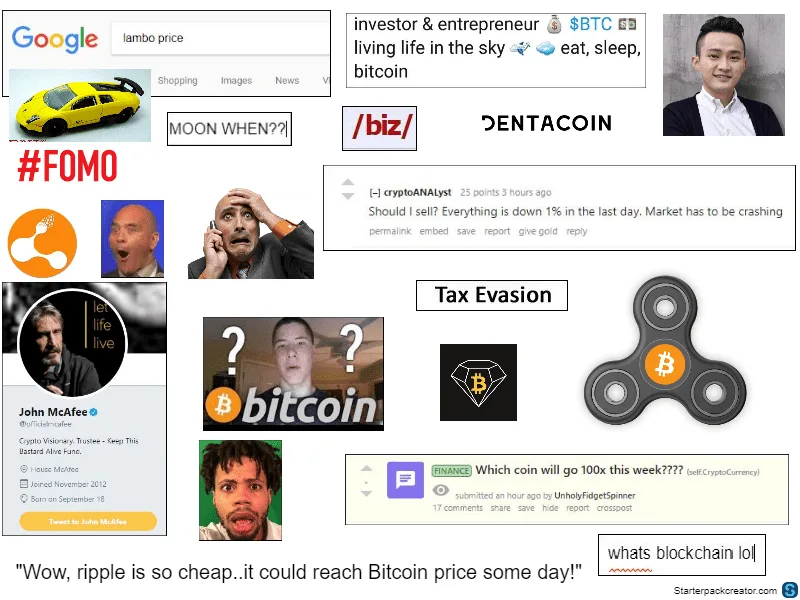
Crypto Trader Starter Pack
References and Resources