Pokémon Cards Go Brrrrrrr
Ten months into 2020 and we’ve already witnessed a plethora of abnormalities pertaining to the financial world- the stock market crash of march, the negative plunge of oil futures, the emergence of a tech bubble, and the might of overly optimistic Robinhood traders, just to highlight a few.
To add to the fiasco, trading cards, specifically Pokémon cards have seen a sudden resurgence and that too as an investment. Turns out this culmination of nostalgia and well, good quality cardboard, has outperformed all conventional asset classes.
Given the potential economic repercussions of COVID-19, majority of the conventional asset classes have struggled to yield promising returns, the S&P 500 has returned approximately 7% while the Dow has returned (-).1%, to put this into perspective the annualised return of the S&P 500 and Dow Jones from 2010 – 2019 (adjusted for inflation, dividends re-invested) has been in the range of 11.2 – 11.5%.
With investors failing to discover robust investments to grow their wealth, Pokémon cards seem to be the perfect departure from their “gloom”. Jokes aside, the valuations of certain Pokémon cards have skyrocketed within the past few months, doubling or even tripling in some cases. Accumulating demand and essentially no new supply of old cards, Pokémon fanatics and collectors have surfaced as millionaires, boasting short-term returns which make Wall Street traders question their existence.
Because humanity still hasn’t progressed enough to establish regulated Pokémon exchanges – National Association of Pokémon Dealers Card Quotations (NAPDCQ) or Squirtle and Pikachu 500 (S&P 00) – these cards tend to trade through auctions, websites like Ebay, or through renowned card collectors. Therefore, due to this absence of a formal platform, the valuations of these cards fluctuate significantly.
Here’s a quick Pokémon Card 101 for anyone who’s willing to “responsibly” “invest” their savings in this “asset class” –
- These Pokémon cards are part of the Pokémon trading card game.
- The value of these cards are determined by the edition or the release of these card packs. Older editions tend to sell for more, First Edition Base Set cards are the rarest and the most valuable.
- First Edition cards furthermore have a hierarchy of common and rare cards. The rarest cards are the “holographic cards”, to elaborate, these cards are shiny and had terribly low production numbers.
- As collectibles, these cards are rated by grading agencies based on their physical condition. PSA is one of the prominent grading scales, PSA 9 and 10 cards are considered to be in pristine shape.
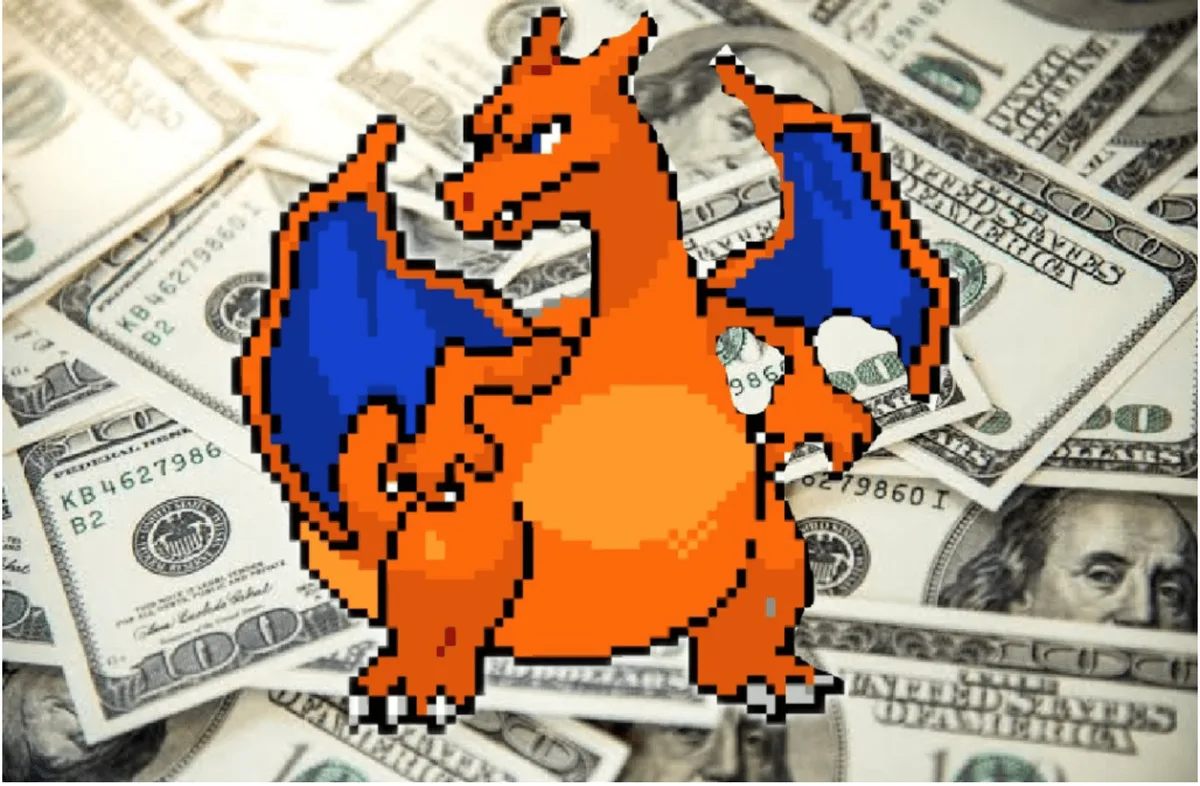
- The cream of the crop with regard to Pokémon cards is the First Edition Base Set Holographic Charizard. These cards can sell for anything between $20,000 to $300,000 depending on the condition.
- Word is that if you possess a Base Set Charizard Holographic card, you’re all secured for a dream retirement.
Now that you’re a Pokemon connoisseur, it’s time to talk numbers. Because there’s no concrete way to evaluate the value of these cards, consequently there’s no feasible way to measure their growth, therefore our best resource to conduct an in-depth “fundamental” and “technical” “analysis” is to skim through Ebay listings and past auctions.
Generally, the PSA 10 Charizard cards which were trading for around the USD 30,000 to 50,000 mark in May-June are now trading for well above the USD 100,000 threshold. That’s a short-term growth of 233%. And because these cards don’t have an intrinsic value or a quantitative underlying asset, their value (besides rarity) floats on market sentiments, primarily “childhood memories” or “nostalgia”, this means that these cards can’t feasibly become “overvalued”, given the qualitative factors continue to favour them. And with Pokémon’s 25th Anniversary around the corner there’s a lot going for these cards here.
Liquidate your portfolio and go all in on Pokémon cards?
If you’ve been following along with the sarcasm in this blog, you already know the answer.
But if I’ve somewhat convinced you to perceive Pokémon cards as a foolproof investment, go ahead you could at least try to “diversify” your investment portfolio a little bit.
To conclude, there is a theory called “Boredom Market Hypothesis”, the basic theory is that ordinary people will do more trading if trading is entertaining and if other things are less entertaining: The more bored they are, the more they will trade stocks.” In this case, Boredom Market Hypothesis seemingly stands true for Pokémon cards.