The Robinhood Phenomenon
Hertz, one of the biggest car rental companies, filed for Chapter 11 bankruptcy on May 22, 2020. This came in after the company had reported losses for 3 consecutive years. The pandemic further impacted the debilitated business, the company is currently 19 billion dollars in debt and has an idle fleet of 700,000 rental cars.
Evidently, for a company on the brink of collapse, Hertz shares took a beating. Shares that were trading for USD 20 on NYSE during the end of February have now plunged to USD 1.45, that’s a 93% decline in market capitalization in less than 6 months.
Trading shares for a company that has filed for bankruptcy is a risky proposition. The common shareholders might abruptly lose the right to sell their stake, given that the company transfers the shares to creditors during debt restructuring. Therefore, your investment in a bankrupt company can go down to USD 0.
However, between May 26 and June 8, Hertz share prices skyrocketed from 0.56 USD to 5.53 USD, that’s an increase of about 900% for a stock that could seemingly become worthless. This anomaly startled experienced investors, who couldn’t justify the sudden surge.
Turns out the blame for the anomaly goes to an online trading platform called Robinhood. The platform aims to “democratize finance for all”, in other works the company plans to enable greater public access to financial markets. While the objective is moral, the approach Robinhood has used is arguably controversial. Where other online trading platforms like TD Ameritrade have used a professional and conventional UI, Robinhood is known for its lively and game-like user interface. For instance, after every transaction the user is awarded with an accomplishment, there is also a leaderboard showing the highest traded stocks of the day. This “youthful” interface has mostly attracted millennials, with Robinhood’s average user being between the age of 28-31.
With a high concentration of millennials, commission-free trading, and a game-like interface, Robinhood is accused of having a significant proportion of inexperienced traders. Stereotypically, these users mostly trade on the “deeply intricate” principle of buy low and sell high, and their investment decisions are based on an “in-depth analysis” of leaderboards. Sarcasm aside, to the experienced investor, Robinhood traders are like monkeys at an exchange.
During the pandemic, online trading platforms have seen a sharp increase in users, Robinhood has added 3 million users to its existing arsenal of 10 million traders.
So what did 13 million monkeys at an exchange do? The answer is absurdly simple, they saw a stock of a prominent company, Hertz, trading below the dollar mark, and well they bought it primarily because it was cheap and affordable. What happens when a lot of Robinhood users buy a particular stock? It goes onto the leaderboard incentivizing other users to hop on the bandwagon. As Robinhood users pushed the demand for Hertz’s stock, its price surged, leading to an unprecedented 900% increase in the company’s market capitalization within 2 weeks. As of now, the stock has plummeted back to around USD 1.45, and Robinhood users have substantially depleted their portfolio valuations.
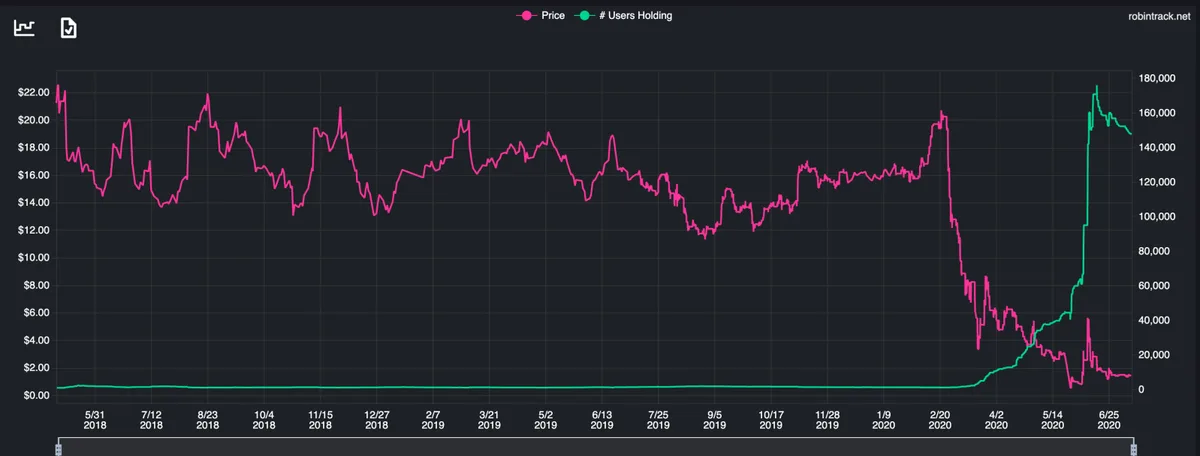
Robinhood user holdings of Hertz stock increased from 1190 (March 1) to 170,814 (July 15). (Source: robintrack)
It’s comical how an army of uninformed individuals significantly disrupted the stock price of a listed company. However, what’s concerning is the theoretical possibility of such an event occurring on the macro level, and the subsequent implications associated with it. With online trading platforms, like Robinhood, essentially offering risky assets to individuals with no prior experience, one wonders the extent to which impulsive and ignorant traders could influence financial markets.