The Story of Yes Bank
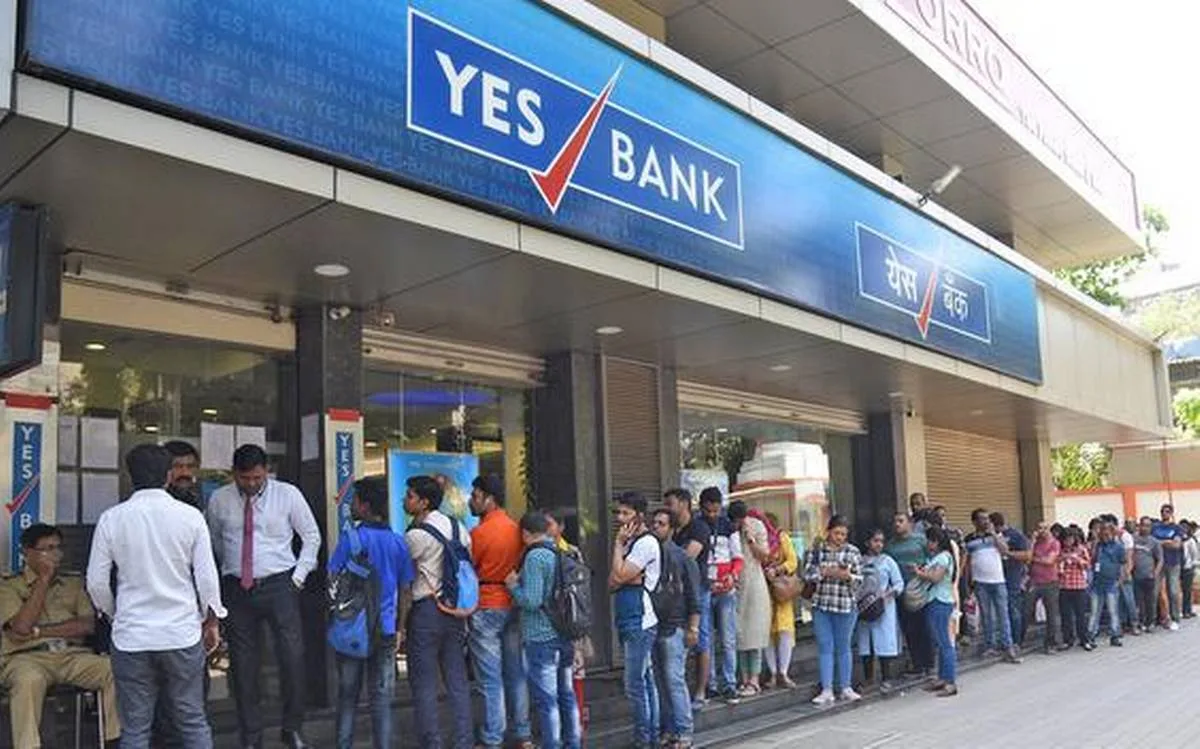
Yes Bank was recently put under moratorium by the RBI, restricting its banking activities for a brief period. Restrictions on withdrawals have initiated widespread panic among the depositors and investors, and the share price has seen an abysmal decline of 50%. Following this incident, the Sensex also fell 900 points (2.3%).The sudden and unexpected collapse of the fourth largest private sector bank has raised significant questions against India’s banking system, which has always been considered to be well anchored and foolproof. However, the events that led to this eventual collapse have much more to do with the internal operations and a liberal approach followed by the bank, than with the economy or the banking system. There’s a unique back story to this bank, enclosed within which are reasons for Yes bank’s unanticipated collapse.
Yes Bank was established by Rana Kapoor, and his brother in law, Ashok Kapur in 2004, soon after the government started allotting banking licenses to the private sector. The experienced and efficient management helped the bank to expand across the country. The highly profitable quarterly and annual reports validated the bank’s exceptional performance and brought in high volume investments from across the globe. Year after year, the bank reported heavy profits constantly pushing up its share price leading to wealth generation and a high degree of investor satisfaction. Consequently, the bank was honored with various banking awards and Yes Bank was hailed as one of the most trusted banks in India. The deposits were flowing in at an increasing pace, the bank was catering heavy loans to top tier companies, the management was strong, the future of Yes Bank looked very promising.
In 2008, however, the exceptional growth of Yes Bank faced a major setback when one of the co-founders, Ashok Kapur, died in the 26/11 Mumbai terrorist attacks. His unfortunate death instantly crashed the share price and led to subsequent unpleasant and relentless legal battles between the two families. These legal battles drastically weakened the management of the bank and surrounded its future with uncertainty. While the lawsuits were being fought, Rana Kapoor, enjoyed total control of the board of directors. Under his control, the bank soon adopted a liberal credit policy wherein the bank aggressively aimed to increase its lost market share. The bank provided risky loans looking at hefty upfront commissions and higher interest rates. Through this approach, Yes Bank increased its interest income and upfront commission significantly, however, this approach was speculative because the bank started extending high volume credit to even stressed companies.
Despite wobbly management and increased exposure to risks, Yes Bank continued to grow at an excellent rate. By 2014, the share price was touching an all-time high (the stock was at an all-time low in 2008). The bank also reported an insignificant 0.31% NPA’s or bad loans, this meant that the bank was able to recover most of the credit it extended. The investors were pleased with the bank’s financials and were confident about continued strong profits in the quarters ahead. Yes Bank’s market value soon crossed 1 lakh crore INR.
Trouble began post-demonetization era when companies faced a cash-crunch and stressed companies started defaulting. The bank was directly exposed to the bankruptcy of companies like IL&FS and Jet Airways, this lead to huge losses. The liberal credit approach initiated by Rana Kapoor started taking its toll on the financials of the company as more and more companies started defaulting. In September 2017, Yes Bank’s NPA’s had more than doubled from 0.83% in the previous quarter to now 1.84%. This was an unprecedented increase that brutally shook the investors. Soon, RBI conducted an audit on Yes Bank NPA’S it reported that Yes Bank had under-reported its NPA’s by around 6355 crores! (equivalent to a divergence of 200%) This news completely eroded investor faith in the company and the share price plummeted. Rana Kapoor was later superseded by Ravneet Gill as CEO.
The change in management seemed to have had a negligible effect on the financials. The NPA’s as per the annual report of 2019 were 3.22% of the total loans extended. In the fourth quarter of 2019, the bank reported a heavy loss of 1507 crores. The bank was heavily in debt and was unable to raise equity to pull itself out of this clutter. The share price which was around 400 INR in 2018 has fallen to 16.20 INR as of March 6 2020.
To highlight, a bank accepts deposits and uses these deposits to grant loans. When the loans start defaulting, the bank enters a stressed state wherein it’s unable to repay the depositors. The heavy losses, constant defaults, and decreasing share prices were eroding Yes Bank’s capital and reputation at an alarming rate. This erosion of capital decreased the amount of liquid funds available with the bank, thereby limiting its ability to meet its obligations. With the current trend continuing, the capital of Yes Bank was becoming insufficient to cover its NPA’s, and therefore the bank would eventually become unable to repay its depositors.
It thus became very necessary for RBI to intervene and protect the deposits of customers. The moratorium has caused initial panic, however, it guarantees the safety of deposits. The State Bank of India is to acquire 49% of Yes Bank at 10 rupees per share, which brings up the total cost of investment to 7250 crores. According to this investment, the valuation of Yes Bank is now just around 16000 crores. Alongside SBI, ICICI, Axis, Kodak and, HDFC bank are also expected to infuse capital into Yes Bank.
After this incident, a lot of unexpected facts and figures have surfaced. For instance, Yes Bank’s loan book exponentially increased from 55,000 crores in 2014 to an astonishing 2,41,000 crores in 2019. What’s more alarming is that in late 2019 a big co-operative bank, PMC Bank, also collapsed due to bad loans. The fact that the unrestricted lending policies of both these banks slipped under the radar of RBI is unacceptable. To prevent incidents like these in the future RBI has now further strengthened its regulations and even extended them to the co-operative sector.
I find it appalling that a bank once valued at 1 lakh crores is now just worth 16000 crores. It’s imminent that Yes Bank’s downfall was primarily due to the liberal credit policies they adopted under the authoritarian control of Rana Kapoor. This unrestricted approach did, in fact, increase their interest income, however, the risky loans exposed them to various stressed companies. The continuous defaults kept on increasing their NPA’s to a point where RBI was forced to take over. The similarities between the collapse of PMC and Yes Bank will act as a wake-up call for RBI, compelling them to undertake various measures to enhance the fundamentals of our banking system.